Liturgical Year · Ages 5-8 · 26 pages
All Souls’ Day: Light a Candle for Abuelo
by Kyle Hancock
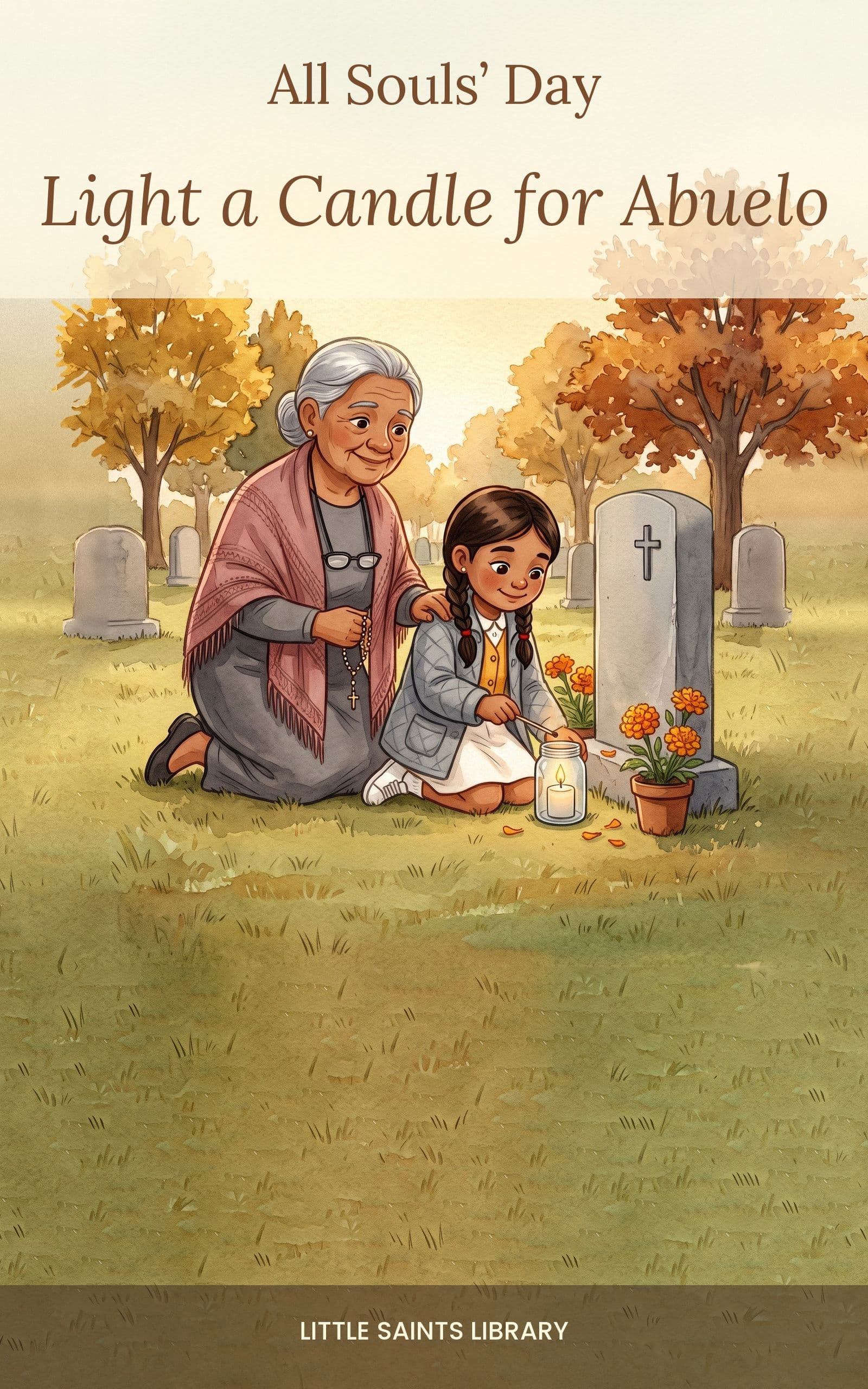
The day after All Saints, Sofía’s family takes a photograph down from the shelf. It is Abuelo — who died before she was born, and whom she knows from Abuela’s stories. Today is All Souls’ Day, and today the family remembers him, and prays for him. Papá tells Sofía the truth gently: Abuelo got sick and his body stopped working; his body rests in the cemetery, in holy ground, but his soul went to God, and one day God will wake his body up too — and it is all right to cry, because even Jesus cried when His friend Lazarus died. Abuela sets a little table under the crucifix, the way her mamá did in Mexico, with his photograph, two candles, a glass of water, his old straw hat, orange marigolds and a round, sweet pan de muerto — not for Abuelo to eat, but to remember him and to help the family pray for him. At church Mamá writes his name in the big book, and Father, in purple, prays for every name at Mass. In the car, when Sofía asks why Abuelo needs our prayers if he is with God, Mamá tells her about purgatory in words a child can hold: our hearts still have smudges, like hands after playing outside, so God washes them clean and makes them ready to see Him face to face — and our prayers help, like holding someone’s hand. In the afternoon the family drives to el camposanto, the holy field. Sofía pulls the weeds, Abuela washes the stone, Papá sets out pots of marigolds, and they stand close together and pray the Church’s own prayer, “Eternal rest grant unto them, O Lord,” while Sofía’s candle burns in its little glass jar. Papá tells how an abbot named Odilo, at the monastery of Cluny about a thousand years ago, began a day of prayer for all God’s friends who have died; Mamá tells how children in England long ago went door to door for soul cakes and promised to pray for each family’s dead — some people think that is where trick-or-treating began. That evening Abuela tells about the day Abuelo made tamales all by himself, and everyone laughs. And at bedtime Sofía folds her hands: “Dear Jesus, please take care of Abuelo. Make him ready to see You. And tell him I love him.” All Souls’ Day: Light a Candle for Abuelo is a gentle first book about death, heaven and purgatory, told in warm watercolor illustrations and simple read-aloud words — a present-day family keeping the day the way millions of Mexican and Mexican-American Catholic families keep Día de los Muertos, with photographs, candles, marigolds and a grave cleaned and lit, and no skulls or ghosts anywhere: only remembering, and prayer. The people we love who have died are not lost. Death is sad, and we may cry. But Jesus has beaten it — and on earth, in heaven and in between, we are one family who hold each other’s hands by praying. Written for ages 4 to 8 — a read-aloud for the youngest, and a first book about death and praying for the dead for children who are starting to read on their own. Inside you’ll find a Scripture page from the Gospel of John (“I am the resurrection and the life”); the story told in short lines little ones can follow; A Note for Families about what the day is, what to tell a child about death, purgatory explained gently and exactly, Día de los Muertos as a Catholic family keeps it, and how to keep the week at home; a prayer to pray together, with a blank for the name of someone you love and the Church’s own prayer for the dead, the Eternal Rest; Talk About It Together, questions for after the story; and a page about All Souls’ Day for the grown-up reading aloud — praying for the dead in the Second Book of Maccabees, St Odilo and the abbey of Cluny (about 1030), the three Masses, the cemetery indulgence, soul cakes — with what is documented and what is debated, clearly marked. Feast days: November 2, All Souls’ Day, the Commemoration of All the Faithful Departed (not a holy day of obligation); November 1, All Saints; November 1–8, the days of the cemetery indulgence.
Get this book
Every download here is free — no paywall, no email required. If you’d rather hold a paper copy, it’s printed on demand and sold at cost. We don’t take a cut.